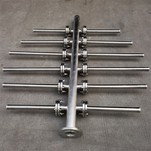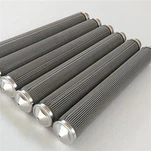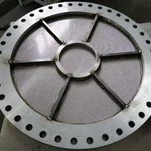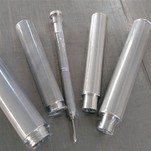
* Raw Material Selection: Depending on the specific filtration medium (such as water, corrosive chemical fluids, high-temperature gases, etc.), appropriate metal materials exhibiting resistance to corrosion and abrasion must be selected. Common choices include various grades of stainless steel, Monel alloys, Hastelloy alloys, and others. The material purity and mechanical properties of the wire stock serve as the fundamental guarantee of product quality.
* Wedge Wire Rolling: This constitutes the prerequisite for creating precise filtration slots. Round metal wires are passed through specialized rolling mills and subjected to multiple passes of cold rolling, gradually deforming into wires with a trapezoidal cross-section and extremely tight dimensional tolerances. The precision of this process directly determines the accuracy of the final filtration slots.
* Support Frame Preparation: Typically, thicker round steel bars or structural steel profiles are utilized and welded-in accordance with design specifications-to form cylindrical or conical cage-like support frames. The straightness and roundness of the frame, as well as the precise positioning of the support ribs, must be strictly controlled.
* Automated Winding and Welding: This represents the core stage of the manufacturing process. On specialized CNC winding machines, the wedge wire is continuously wound around the support frame at a predetermined tension and pitch. Crucially, every contact point between the wedge wire and the support ribs is firmly bonded via methods such as resistance welding or laser welding. This ensures that the position of every wire coil remains fixed, thereby enhancing the overall structural rigidity and preventing any loosening during operation.
* End Sealing and Shaping: Once the winding process is complete, the ends of the filter element must undergo sealing treatment to prevent fluid bypass (short-circuiting). The entire assembly may also require straightening and rounding to ensure that its installation dimensions comply with established standards.
* Surface Treatment and Quality Inspection: Depending on specific requirements, surface treatments-such as polishing or acid pickling and passivation-may be applied to enhance surface characteristics or improve corrosion resistance. The finished filter element undergoes rigorous quality inspection, including visual examination, dimensional measurement, and-where necessary-air tightness testing and precision sampling checks.