
Sintered Fibre Felt Material and Filter
Sintered Metal Fiber Felt & Filter Elements: High-Porosity Depth Filtration Solutions
Sintered metal fiber felt is a non-woven, three-dimensional porous filtration medium manufactured by vacuum sintering micron-grade metallic fibers. Unlike woven wire mesh or sintered powder, metal fiber felt achieves up to 80% to 85% porosity while maintaining structural integrity under high pressure and temperature extremes.
Designed for high-viscosity polymer filtration, aggressive liquid chemical clarification, and high-temperature gas solid-liquid separation, our sintered fiber felt filter elements deliver high dirt holding capacity, low initial pressure drop, and extended online service intervals. They serve as reliable drop-in replacements for standard OEM filtration cartridges.
-
 Sintered Fiber FeltProduct name: Sintered Fiber Felt, 3micron SS sintered fiber feltProduct Type: Non - protected Sintered Fiber Felt, Sintered Fiber Felt With Protected MeshMaterial: SUS304,316,316LFilter Micron:Add to Inquiry
-
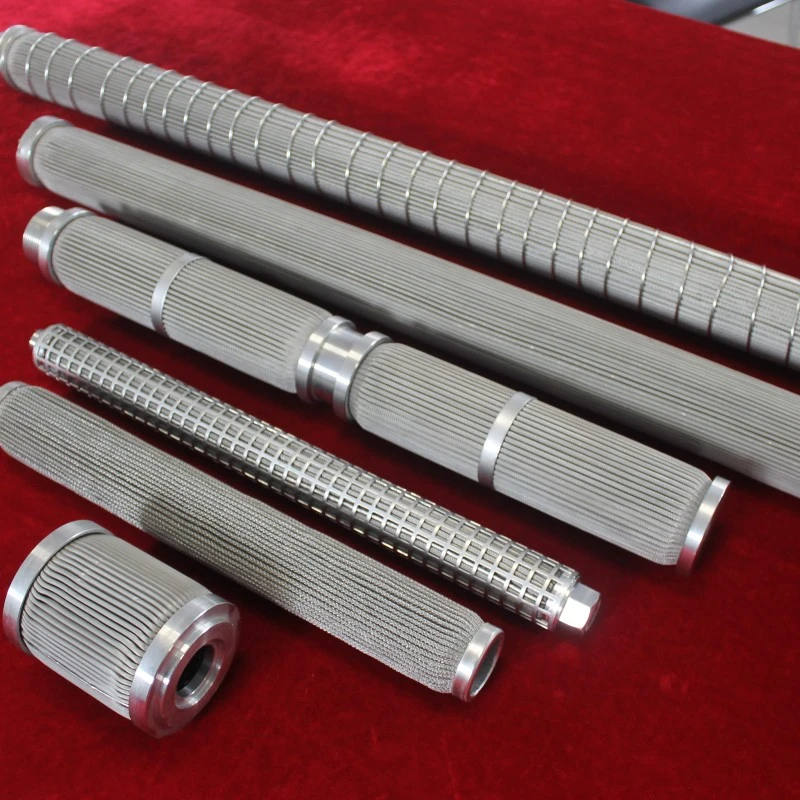
 Sintered Fiber CartridgeProduct Name: Sintered Fiber Cartridge, Sintered fiber filter element. Product Type: Sintered fiber felt filter. Material: SUS304, 304L, 316, 316L. Filter Micron: 3um-50µ. Size: it isAdd to Inquiry
-
 Sintered Fiber Pleated FilterProduct Name: Sintered Fiber Pleated Filter. Product Type: Sintered Fiber Pleated Cartridge. Material: SS316L, SS304 or customized according to requirment. Filter Micron: 1um-300µm. Size: customizedAdd to Inquiry


Type & Specifications
|
Parameter |
Standard Specification Range |
|
Filter Media Grade |
1 micron to 100 micron (Absolute Rating per ISO 4572 / Multi-pass) |
|
Porosity |
65% to 85% |
|
Standard Alloys |
316L Stainless Steel, Alloy 2205, Hastelloy C-276, Titanium Grade 1/2 |
|
Structure Options |
Non-protected felt / Protective mesh sandwich (Single or Double layer) |
|
Sheet Dimensions |
500 mm x 1000 mm, 1000 mm x 1200 mm, or custom sheared sizes |
|
Cartridge Outer Diameter |
60 mm, 65 mm, 70 mm, or customized to housing specs |
|
Cartridge Length |
10 inch, 20 inch, 30 inch, 40 inch (254 mm to 1016 mm) |
|
End Cap Configurations |
DOE, Code 7 (226 O-ring with Spear), Code 3 (222 O-ring with Flat), NPT |
Material & Filtration Performance
High Porosity & Low Pressure Drop
The random non-woven matrix yields an open-pore volume between 65% and 85%. This yields a lower initial pressure drop (Delta P) compared to sintered powder media at equivalent micron ratings, reducing overall system pump energy consumption.
Superior Dirt Holding Capacity (DHC)
The 3D depth structure captures contaminants throughout the entire media volume rather than solely on the surface. Test data under ISO 16889 demonstrates up to 3 times greater contaminant retention capacity over conventional sintered wire mesh.
Zero Fiber Migration
Fibers are solid-state diffusion bonded at all crossover points during high-vacuum sintering. The resulting structure eliminates fiber shedding into downstream process flows, protecting sensitive turbines, spray nozzles, and catalytic reactors.
Thermal & Corrosion Resistance
316L Stainless Steel: Continuous operating temperatures up to 480 degrees C in oxidizing environments and up to 600 degrees C in inert environments.
Hastelloy C-276 / Inconel 600: Engineered for strong acid streams, moist chlorine gas, and severe chemical processing up to 815 degrees C.
Titanium Grade 1 / Grade 2: Preferred for chloride-rich marine environments and acidic electrolysis cells requiring lightweight, highly corrosion-resistant media.

Polymer & Resin Production: Melt filtration for PET, PBT, PC, and nylon extruders to remove gels and micro-particulates before fiber spinning or film casting.
Petrochemical & Refinery Operations: Catalyst recovery, slurry oil filtration, and amine gas sweetening loops.
Hydrogen Production & Fuel Cells: Gas diffusion layers (GDL) and porous transport layers (PTL) in PEM electrolyzers; high-purity hydrogen gas purification.
High-Temperature Gas Cleanup: Flue gas dedusting, hot syngas filtration, and continuous casting exhaust treatment.
Pharmaceutical & Beverage Processing: High-pressure steam sterilization and aggressive solvent recovery.
Model Selection Guide
To specify or cross-reference a sintered metal fiber felt element, identify the following core requirements:
Defines media material selection (316L vs Hastelloy) and target surface velocity.
Normal and maximum temperature (degrees C), continuous operating pressure (bar), and allowable maximum differential pressure (Delta P).
Absolute micron rating (for example, 3 micron absolute vs 10 micron nominal).
Pleated Cartridge: Maximizes effective surface area (up to 0.5 square meters per 10-inch length) for high flow rates and low space velocity.
Cylindrical / Smooth Cartridge: Designed for heavy cake loading, high-viscosity fluids, and continuous ultrasonic or backwash cleaning.
Flat Sheared Disks / Leaves: Used in leaf filters, resin pack screens, and specialized test rigs.
Manufacturing & Quality Control
Manufacturing Flow
Raw Fiber Slicing & Carding -> Uniform Web Laying & Calendering -> High-Vacuum Sintering Furnace (1100 to 1250 degrees C) -> Bubble Point & Pore Size Distribution Testing -> Automated Pleating & TIG / Plasma Welding -> 100% Helium Leak & Pressure Integrity Inspection -> Ultrasonic Solvent Degreasing & Cleanroom Packaging
Testing & Traceability
Raw Material Validation: Positive Material Identification (PMI) chemical analysis on all incoming alloy lots.
Pore Size Integrity: Verified per ISO 4003 (Bubble Point Method).
Air / Liquid Permeability: Tested per ISO 4022 standards.
Structural Integrity: Collapse pressure tested up to 210 bar differential pressure (per ISO 2941).
Material Traceability: Full Mill Test Reports (MTR) provided according to EN 10204 3.1 for chemical composition and mechanical properties.
OEM & Customization Capabilities
Direct Retrofit Drop-In Elements
Dimensional mapping to replace existing OEM cartridges without modification to filter housings.
Multi-Layer Laminations
Sintering metal felt together with inner and outer protective wire mesh layers to resist mechanical stress during high-pressure backflushing.
Custom End Cap Machining
In-house CNC turning and milling for specialized flange profiles, thread pitch, and custom sealing interfaces.
Prototyping & Short-Run Orders
Sample flat sheets or prototype filter elements supplied with full test data for bench-scale pilot trials.
FAQ
As one of the leading sintered fibre felt material and filter manufacturers and suppliers in China, we offer a wide range of products with superior quality. Please rest assured to buy advanced sintered fibre felt material and filter from our factory. We also accept customized orders.
Sintered Fiber Cartridge, customized sintered fiber pleated filter, 5micron sintered fiber filter element