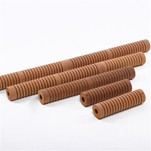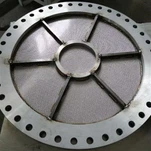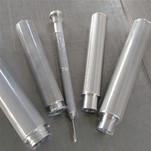
The primary raw material for sintered metal filter elements is metal powder. Common materials include stainless steel (such as 304, 304L, 316, and 316L), titanium, nickel-based alloys (such as Hastelloy and Inconel), and Monel alloy; the selection of materials is based on their corrosion resistance. The manufacturing process typically comprises steps such as raw material preparation, batching, forming, and sintering. During the raw material preparation phase, the metal is processed into powder of the required particle size. Batching involves mixing the metal powder with binders, sintering aids, and other additives in specific proportions to create a homogeneous mixture. Forming is the process of compacting this mixture within a mold-using either pressure or vacuum suction-to create the desired shape, such as cylindrical, square, or conical. Sintering involves heating the formed filter element in a sintering furnace to a temperature between 800°C and 1200°C and maintaining this temperature for a specific duration. Since this temperature remains below the metal's melting point, the powder particles bond through diffusion without actually melting, thereby forming a porous solid structure.
Following sintering, the resulting products exhibit a wide range of porosities (28%–50%), pore sizes (4 µm–160 µm), and filtration precisions (0.2 µm–100 µm) [6]; the filtration precision range can extend from 0.1 µm to 100 µm. These filter elements can be fabricated with either single-layer or multi-layer structures, and are available in various shapes-including circular, square, rectangular, elliptical, and annular-with diameters ranging from a minimum of 2 mm to a maximum of 450 mm, and thicknesses ranging from 1 mm to 20 mm.
Depending on specific requirements, special post-processing treatments may be applied after the forming and sintering stages. A high-pressure compaction process, utilizing pressures of up to 800–1000 MPa, may be employed to increase the material's density. A centrifugal spinning process involves rotating the material at speeds of 1000–1500 rpm to centrifugally expel molten metal from the pores, thereby creating specific structural configurations. An acid pickling process involves immersing the sintered filter plate in a dilute nitric acid solution (with a mass concentration of 3%–10%) for a period of time, followed by rinsing with deionized water. Furthermore, the process involves additional manufacturing steps, such as rolling the filter plates into a tubular shape and performing longitudinal seam welding.
Sintered metal filter elements can be cleaned and regenerated. Cleaning methods include placing the element in a nitrogen-purged oven and heating it to 380°C for approximately two hours, ultrasonic cleaning, and backwashing. After repeated cleaning and regeneration cycles, the filtration performance can be restored to over 90%.