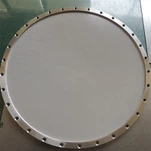
The core of this wire-wound filter screen lies in its specialized wire processing and winding-forming technologies. The metal wire utilized undergoes a rolling process to create a unique geometric profile-specifically, a trapezoidal cross-section-known as a "wedge-shaped" profile. During manufacturing, these wedge-shaped wires are tightly and helically wound around a series of longitudinally oriented support rods arranged in a specific pattern. By precisely controlling the winding tension and spacing, a continuous, uniform filtration slot with a constant aperture size is formed between adjacent wedge-shaped wires.
This structure endows the filter with several distinct characteristics:
* High Slot Uniformity: Thanks to the use of pre-formed wedge wires and precision winding machinery, the slot width across the entire filtration surface remains highly consistent. This eliminates the issue of non-uniform slot sizes-often caused by overlapping nodes-that is common in traditional woven wire screens. Consequently, filtration precision is highly controllable, enabling the effective retention of solid particles exceeding a specific size.
* High Structural Strength: The internal support framework and the external wedge wires combine to form a robust, integral unit. This structure is capable of withstanding high fluid pressures and operational loads; it resists deformation or damage under pressure fluctuations, thereby ensuring the long-term stability of the filtration process.
* Clog-Resistant and Easy to Clean: The internal flow channels within the filtration slots formed by the wedge wires are smooth and gradually narrowing. Most retained solid particles accumulate on the outer surface of the filter element rather than becoming embedded deep within the slots. This "narrow-on-the-outside, wide-on-the-inside" V-shaped channel design makes the backwashing process highly efficient, allowing accumulated impurities to be easily flushed away and thereby extending the service life of the filter element.
* High Flow Capacity: Despite the minute size of the individual slots, the entire filter element consists of a multitude of parallel filtration channels; consequently, the total open filtration area is relatively large in proportion to the element's overall physical dimensions. This ensures that fluid encounters relatively low resistance as it passes through, thereby enabling the achievement of high flow rates.